


PHOENIX (CN) - The fourth-most populous county in the United States could be chopped down into four separate counties if Arizona Republicans can avoid the governor's veto.
Maricopa County is home to more than 4 million people, most of whom live in the state capital of Phoenix. It makes up more than 60% of the state's total population and nearly 70% of registered voters, and is governed by just five county supervisors.
"It's far too few people representing too many people," state Senator Jake Hoffman said in a Senate Government Committee meeting Wednesday morning. "We are subjecting ourselves to a very dangerous model of government where we have only five people making decisions for 90% of the state."
By population, Maricopa County is larger than 109 countries and 26 U.S. states.
"At our current rate of growth, we're going to be larger than 28 states," the Queen Creek Republican said.
To prevent the county from growing to an unmanageable size, Hoffman sponsored two bills that would split the county into four pieces, splitting the city of Phoenix in the process.
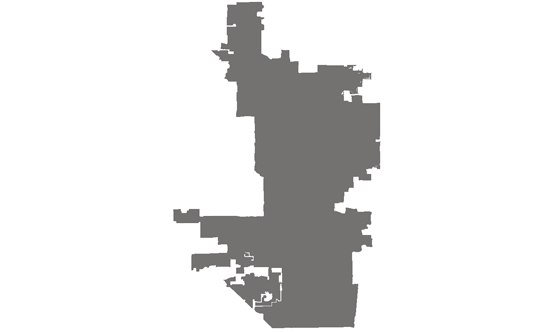
The more popular proposal, Senate Bill 1434, would shrink Maricopa County to include only central and southern Phoenix along with the neighboring towns of Tempe, Tolleson and Guadalupe, with a total population of 1.8 million. The remaining land would be used to create three new counties.
Mogollon County would cover northern Phoenix and the northeast valet, including Scottsdale, with a total population of 838,200. Hohokam County would cover most of the east valley, including Mesa and Hoffman's city of Queen Creek, with a total population of 1.2 million. O'odham County would cover the west valley, including Glendale and Peoria, with a total population of 758,800.
Hoffman first proposed the bill in 2023, but Democratic Governor Katie Hobbs vetoed it. He proposed it again in 2025, but that version never left the Senate.
The split would require the three new counties to hold special elections to establish their own boards of supervisors while the Maricopa County board retains power through a transition period of up to three years. The joint legislative budget committee estimates that the action would increase county costs by at least $162 million annually for 33 newly elected officials and more than 1,000 new staff positions across the three counties.
"What we're looking to do here is cause chaos and raise costs when there's no benefit to tax payers," Democratic state Senator Lauren Kuby countered Wednesday morning.
She said Hoffman failed to consider logistical hurdles like establishing new courts and sheriff's offices and prorating county debts and expenditures. Kuby suggested, as was said about previous iterations of the bill, that Hoffman's proposal is nothing more than "legislative revenge" over the county's handling of the last few elections.
Hoffman responded by explaining the split would actually give Democrats a larger share of control over the same total population. Now, four of the five county supervisors are Republican. Hoffman said the split would give Democrats complete control over one county and at least a seat in the other three.
It's unclear what costs would be fronted by the state, but the bill acknowledges some potential effect on the state's general fund if the new counties qualify for state assistance that Maricopa County doesn't already receive.
As an alternative, Hoffman offered Senate Bill 1433, would shrink Maricopa County in the same way as the aforementioned bill, but would split the remaining land among the five adjacent counties:
- Yavapai County would absorb northern Phoenix and portions of the west valley
- La Paz County would absorb the rest of the west valley including Buckeye and Goodyear
- Gila County would absorb Scottsdale and the surrounding area
- Pinal County would absorb the east valley including Mesa, and Queen Creek
- Yuma County would gain Gila Bend
Kuby, representing Tempe, said the proposal will only put people in the newly altered surrounding counties even further geographically from their government.
"I just don't think this bill has been thought through," she complained.
Thanks to a population increase, both La Paz and Gila Counties would be required to add two more members to their currently three-member boards of supervisors. Maricopa County's budget would decrease as a result.
In a note attached to the bill, the joint legislative budget committee says it fears the changes will affect state funding and sales tax levied by the counties with increased populations, but is unable to provide clear estimates at this time.
The Senate Government Committee voted 4-3 on party lines to advance both bills to the Senate floor.
Source: Courthouse News Service